
Bay of Kotor Boat Tour: Our Lady of the Rocks & Blue Cave
Bay of Kotor boat tour guide: what you see from the water - Our Lady of the Rocks, the Blue Cave, Mamula - plus prices, season and what to bring.
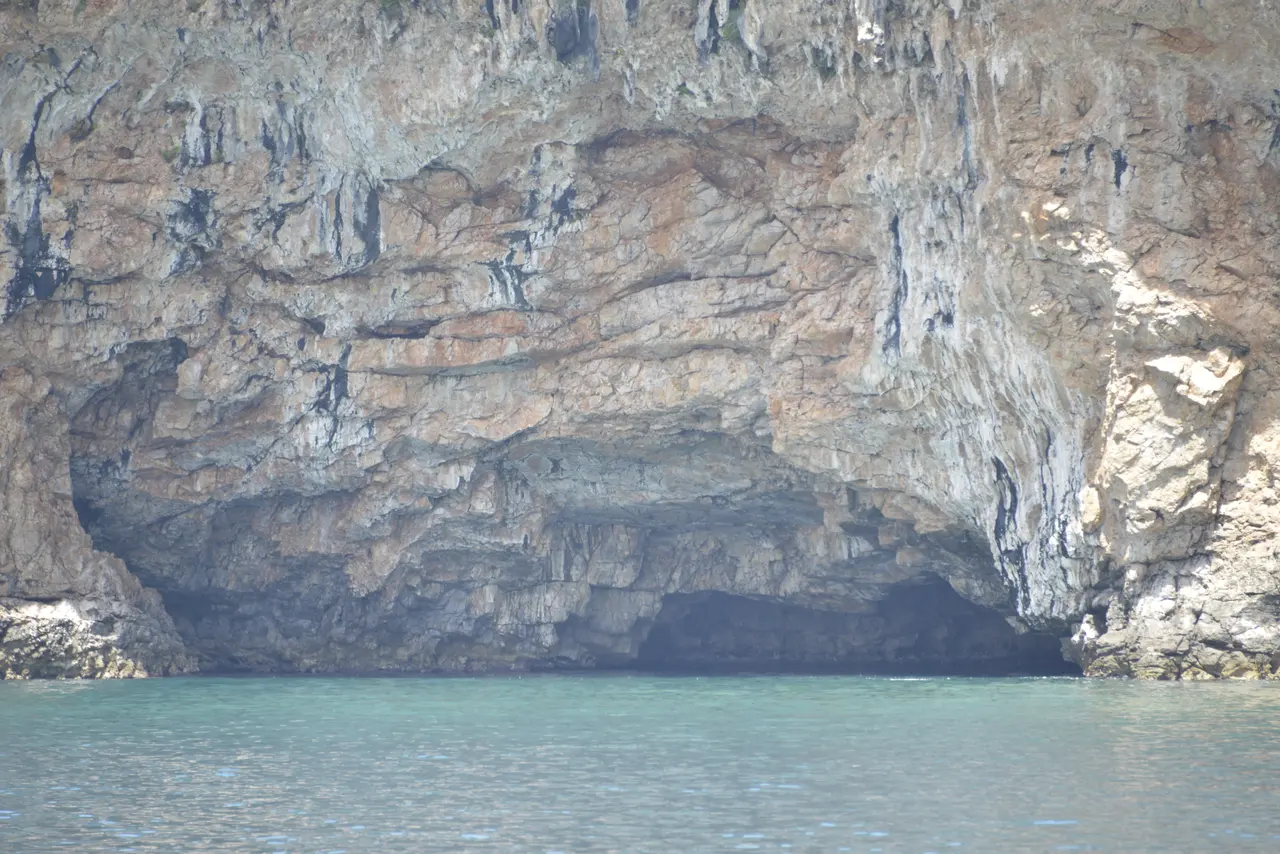
Yes - a boat tour is the best way to see the Bay of Kotor, and for many people it’s the highlight of the whole coast. From the water you reach two things you cannot properly see from land: Our Lady of the Rocks, the church Perast’s sailors raised on an island they built by hand, and the Blue Cave (Plava Špilja), a sea grotto where the water turns electric blue around you. Most trips run April to November, take half a day to a full day, and pass mountains, old sea-captains’ towns and a decommissioned submarine tunnel along the way. Below is what you actually see, where boats leave from, what it costs and how to pick the right tour.
Is a Bay of Kotor boat tour worth it?
Short answer: if you have a spare morning on the coast, take one. The bay is often called Europe’s southernmost fjord - geologically it’s a drowned river canyon (a ria) rather than a true fjord, but the effect is the same: sheer grey mountains falling straight into deep, still water, with tiny stone towns clinging to the shore. From the road you glimpse it in slices between tunnels. From a boat you get the whole sweep, plus the two star sights that are simply unreachable on foot.
The other honest reason is logistics. Our Lady of the Rocks sits on its own island; the Blue Cave is a hole in a cliff on the open-sea side of the Luštica peninsula. There is no walking to either - a boat is the only way in. So a tour isn’t just a scenic add-on here; it’s the actual transport to the headline attractions. The scenery in between is the bonus.
Our Lady of the Rocks (Gospa od Škrpjela)
This is the one on the postcards: a blue-domed church sitting on a flat little island in the middle of the bay, just off Perast. What most visitors don’t realise is that the island is entirely man-made - the only artificial island in the Adriatic. According to Wikipedia and local guides, the story goes back to 1452, when two sailors are said to have found an icon of the Madonna and Child on a rock in the sea on 22 July. From then on, returning crews dropped a stone on the reef after each safe voyage, and over the centuries - helped by scuttling more than 100 old and captured ships loaded with rock - a whole island rose out of the water.
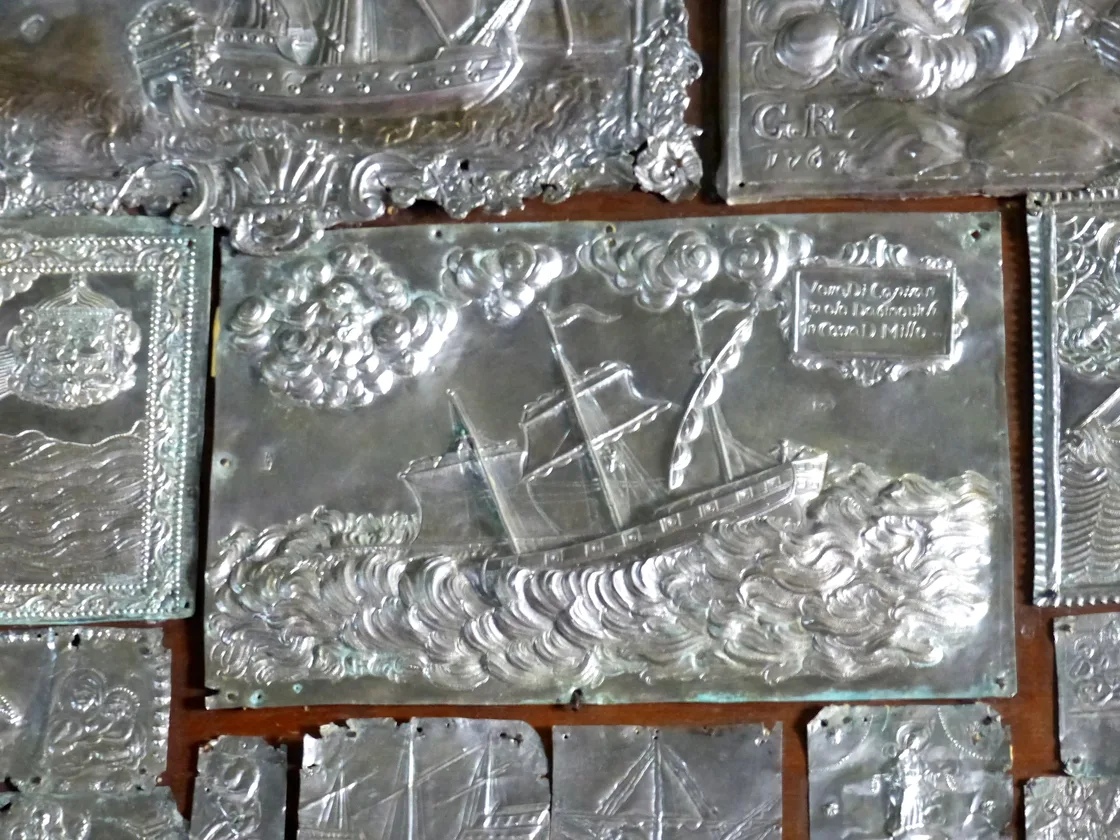
Inside, the church museum is worth the few minutes it takes. It holds 68 paintings by Tripo Kokolja, a Baroque artist born in Perast, whose ten-metre canvas The Death of the Virgin runs across the ceiling; there’s the original 1452 icon attributed to Lovro Dobričević of Kotor, and walls plated with roughly 2,500 silver votive tablets left by sailors and their families as thanks for safe returns. The oddest exhibit is a tapestry embroidered by a local woman, Jacinta Kunić-Mijović, over about 25 years - she is said to have worked strands of her own hair into it, and you can see it fade from gold to grey as she aged.
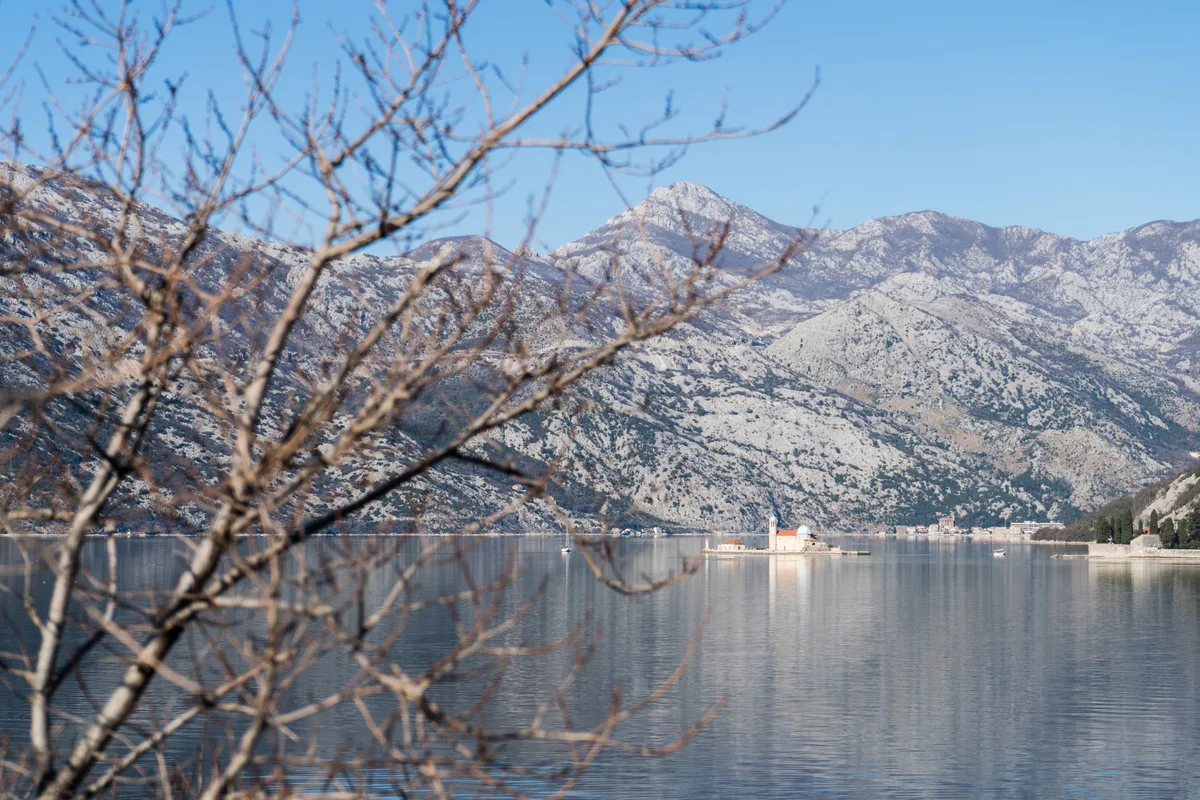
A quick note on the neighbour. The second islet beside it, St George (Sveti Đorđe), is a natural island with a Benedictine monastery and a stand of dark cypresses. It’s the more photogenic of the two but it’s closed to visitors, so you’ll circle it, not land on it. If you want the island’s living tradition rather than the museum, come on 22 July for the Fašinada: at sunset a line of flower-decked boats rows out from Perast and drops stones by the island, the same act that built it, repeated every year.
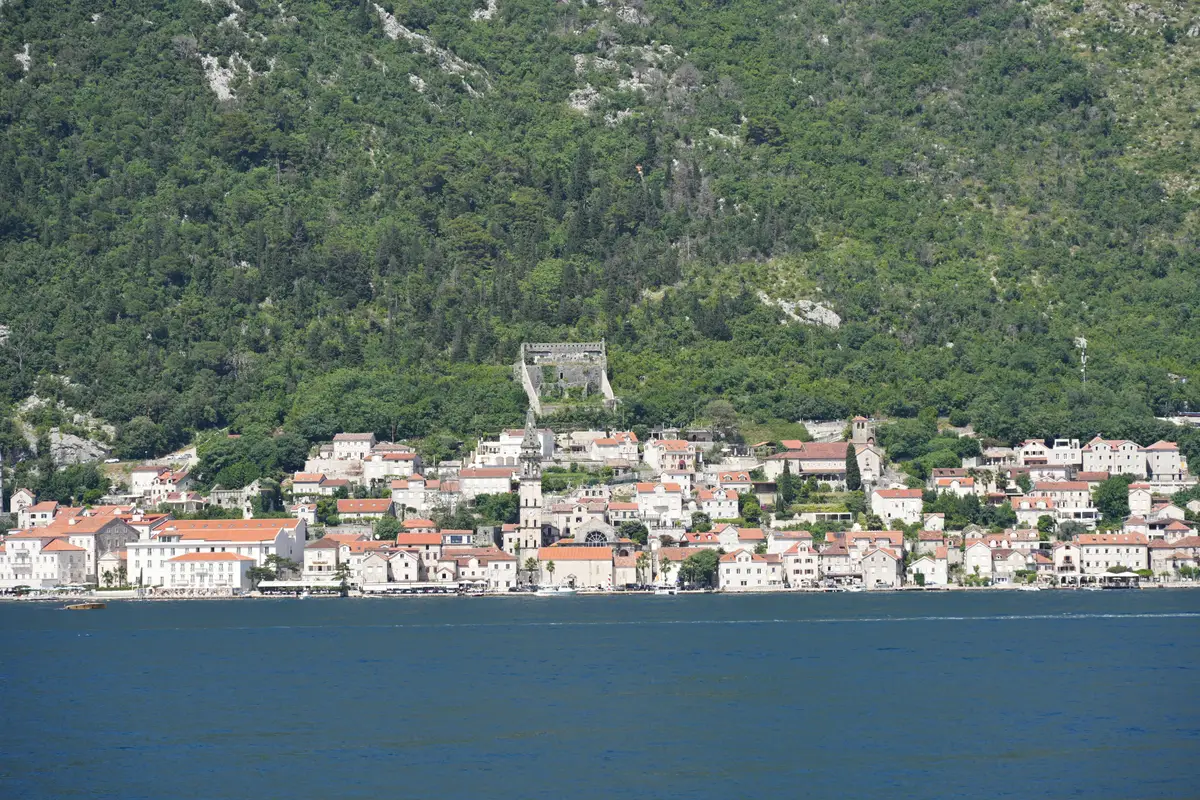
Visiting it on your own: you don’t strictly need a tour for this one. Small taxi boats shuttle from the Perast waterfront in a few minutes; local guides quote roughly €5 per person return (some report up to €10), usually with a 30-45-minute wait while you look around. Island entry with the short guided visit of the church and museum is a small fee - often quoted around €2 - and the island generally opens around 9:00 to 18:00 daily in season. Treat those numbers as a guide and check on the spot; prices and hours drift year to year. One firm rule: this is a working Catholic church, so swimwear is not allowed inside - bring something to cover shoulders and knees. For the town itself - the tall bell tower, the Baroque palazzi and how to plan the island visit - see our full Perast and Our Lady of the Rocks guide.
The Blue Cave (Plava Špilja)
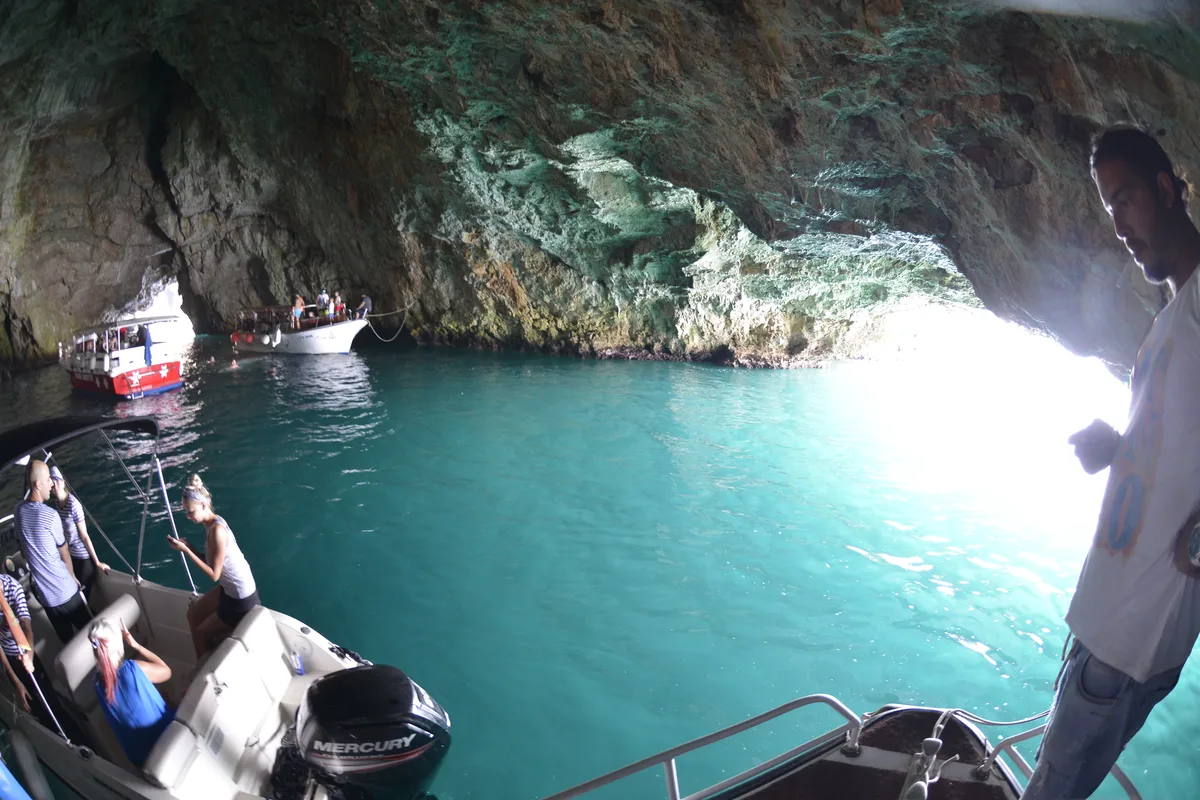
The Blue Cave is the other half of the classic day, and it delivers a genuinely strange effect. It’s a sea cave cut into the limestone cliffs of the Luštica peninsula, on the open-Adriatic side just outside the bay near Herceg Novi. Daylight comes in below the waterline, reflects up from a light-coloured seabed and fills the cave with that electric blue, so the water seems lit from underneath. Since May 2026 the boat stops short of the low mouth, because under the ministry’s navigation rules nothing with an engine may enter, and on most trips you get to swim in yourself for ten or fifteen minutes in that blue light.
Practical facts worth knowing before you go. The water is fairly shallow near the cave (guides say around 5 m, deeper further out), and in summer it sits at a swimmable 20-22°C; every boat has a short ladder for climbing back in. The blue is at its best when the sun is high - roughly 10:00 to 13:00 - so an earlier tour both catches better light and beats the mid-morning traffic jam of boats in peak July and August. The cave itself is free; you’re paying for the boat, not the entry. A small honesty note: that difference between operators has gone, because motorized craft can no longer go inside at all, so what varies now is the swim time your skipper allows and how near the mouth the boat anchors. Anyone booking mainly for the swim should ask about both before paying. For a cave-focused trip - which port to leave from, prices and the best time of day - see our dedicated Blue Cave Montenegro guide.
What else the tour usually stops at
A Blue Cave trip is rarely just the cave. The peninsula is packed with quick, odd, worthwhile stops, and a well-run three-hour speedboat tour can string several together:
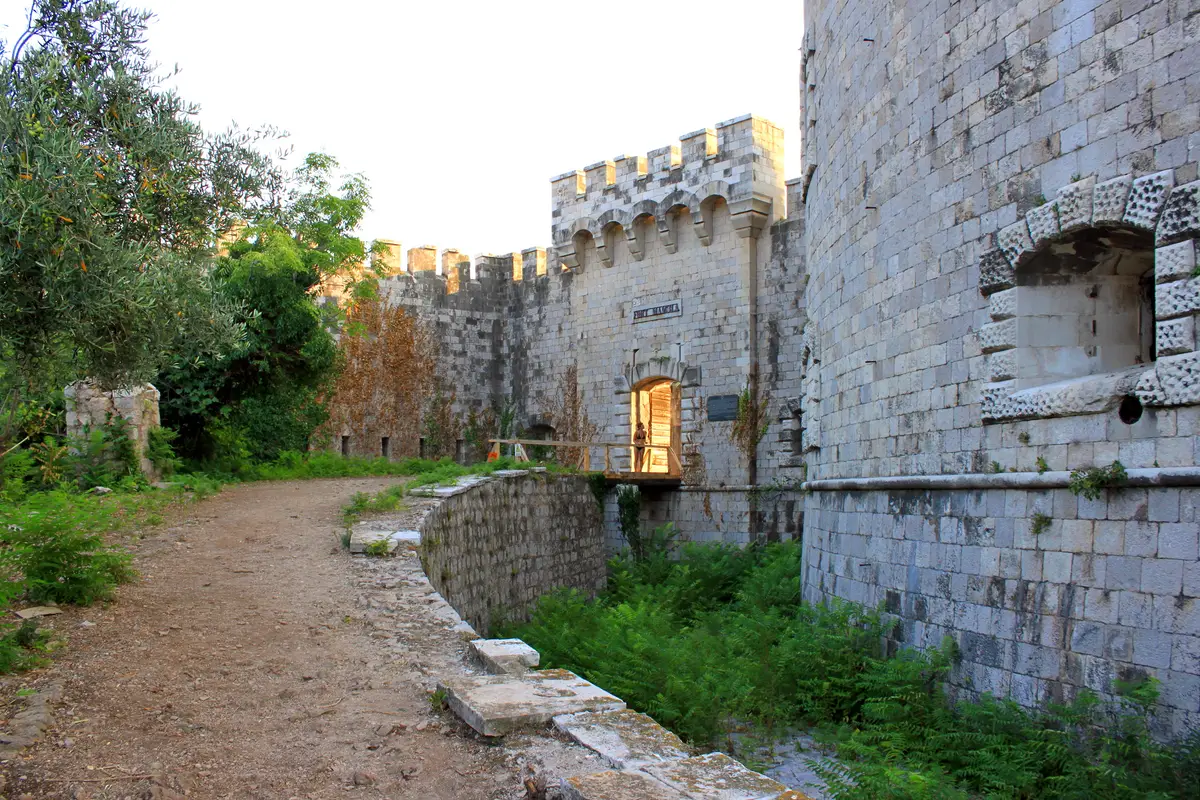
- Mamula island - a round stone fort that covers its whole islet where the bay opens to the sea, built by the Austrians in the 1850s and used as a prison in the Second World War; it has since been turned into a luxury hotel. Most tours circle it for the photo rather than landing.
- The submarine tunnel at Rose - a Cold-War-era tunnel cut into the rock in the 1970s, where the Yugoslav navy hid submarines. Boats slip inside the dark mouth; it’s the kind of thing you’d never find on your own.
- Žanjice - a long pebble beach on Luštica, the usual spot for a second, calmer swim and a drink before the run home.
- Our Lady of the Rocks - many Blue Cave tours from Herceg Novi or Tivat loop back past the island on the return, so you can get both stars in one outing.
Where boats leave from, and how to choose
Where you start shapes what you see. Kotor and Perast are the natural bases for a bay tour focused on Perast and Our Lady of the Rocks - short hop, calm water, good for a couple of hours. For a Blue Cave trip you want to start closer to the open sea: Herceg Novi, Luštica Bay or nearby Žanjice are the shortest run, with Tivat (Porto Montenegro) and Budva also offering longer tours that take in more of the coast on the way. If the cave is your priority, picking a western departure means less time in transit and more time in the water.
Then there’s the choice between a group and a private boat. A group speedboat is the cheapest and simplest - fixed departure, set route, usually three to four hours, shared with a dozen strangers; a full-day catamaran cruise stretches to around eight hours at a gentler pace. A private boat (often up to about 15 people) costs more but lets you set the route, the timing and how long you linger - worth it for a family, a group splitting the cost, or anyone who wants to hit the cave at 09:00 before the crowds. For skippered hire rates, bareboat rules and where to pick up a hull, see renting a boat in Kotor Bay. For planning the wider trip, our guide to getting around Montenegro covers how the coast connects, and the Kotor guide has more on the town most tours leave from.
Prices and season
Prices here are moving targets: season, operator and group-versus-private all shift them, so read every number below as a starting point and check it before paying. As a rough guide, group tours from Kotor or Tivat tend to start around €30 per person; the short taxi-boat from Perast out to Our Lady of the Rocks is much cheaper at roughly €5-10 return. As a real example, Petar Boats, which runs out of Herceg Novi, advertises its Blue Cave trip (Mamula, the cave swim and the Rose submarine tunnel) at €30 per adult, €15 per child aged 6-11, free under six, leaving from Igalo and Herceg Novi - useful as a benchmark, though you should compare a few operators for what’s included.
Season runs roughly April to November, boats go out daily in summer with the most departures in July and August, and those are also the cave’s most crowded weeks, so an early start pays off. For choosing your dates, see our when-to-visit guide: in late spring and in September the sea is warm and usually calm, and the July crowds are absent. For a sense of how a boat day fits alongside the rest of the coast, the things to do in Montenegro round-up has the other headline sights.
What to bring
Pack light but pack right. Sunscreen and a hat - you’re exposed on open water for hours; a swimsuit and towel for the cave and Žanjice; water, since not every boat sells drinks; and sunglasses. A light layer is smart even in summer - a speedboat at pace generates real wind-chill. Wear comfortable, non-slip shoes for wet decks and the island’s stone steps, bring a snorkel and mask if you have them, and keep a cover-up handy for the church, where swimwear isn’t allowed. Phones and cameras survive the spray better in a dry bag.
One last tip: book the earliest slot you can bear. The light in the Blue Cave is best mid-morning, the sea is usually calmest early, and by late morning in high season a dozen boats are anchored off the same low cave mouth waiting for swimmers to come back aboard. Arrive ahead of them and you’ll have the blue almost to yourself.
Nearby / read also
- Kotor travel guide
- Rent a boat in Kotor Bay - when a self-drive hire beats a fixed-route tour
- Bay of Kotor boating rules - speed zones, the Blue Cave motor ban and who may hold the wheel.
- Getting around Montenegro
- Best time to visit Montenegro
- Is Kotor worth visiting? - the old town that most boat days start from
On the map
The map loads on click - to keep the page lightweight.
The map didn’t load. Check your connection and refresh the page.
Distance
- Tivat ≈8 km · ≈12 min to Kotor quay, ≈35 min to Perast from Tivat airport (TIV)
- Budva ≈22 km · ≈35-40 min to Kotor
Read also

What to see · 10 min read
Hiking Bobotov Kuk: Durmitor Highest Peak
Verified · September 4, 2026Bobotov Kuk hike at 2,523 m: Sedlo (~10 km RT) vs Lokvice from Black Lake, €5 park fee, cables, season and early-start tips.

What to see · 10 min read
Swimming in the Bay of Kotor: Beaches & Lidos
Updated · August 31, 2026Can you swim in Kotor? Yes - on Dobrota pontoons, Morinj and small Boka shores. Water quality, season and what to expect.

What to see · 11 min read
Rent a Boat in Kotor Bay: No Licence Needed
Updated · September 25, 2026Private boat rental in Kotor Bay 2026: skippered hire from €90/h, bareboat prices, licence rules, speed limits and where boats leave from.

What to see · 9 min read
Piva Lake & Canyon: Montenegro's Emerald North
Updated · August 27, 2026Piva Lake guide: the 45 km emerald reservoir, Mratinje Dam, boat trips from Plužine, the relocated Piva Monastery and how to pair it with Durmitor.